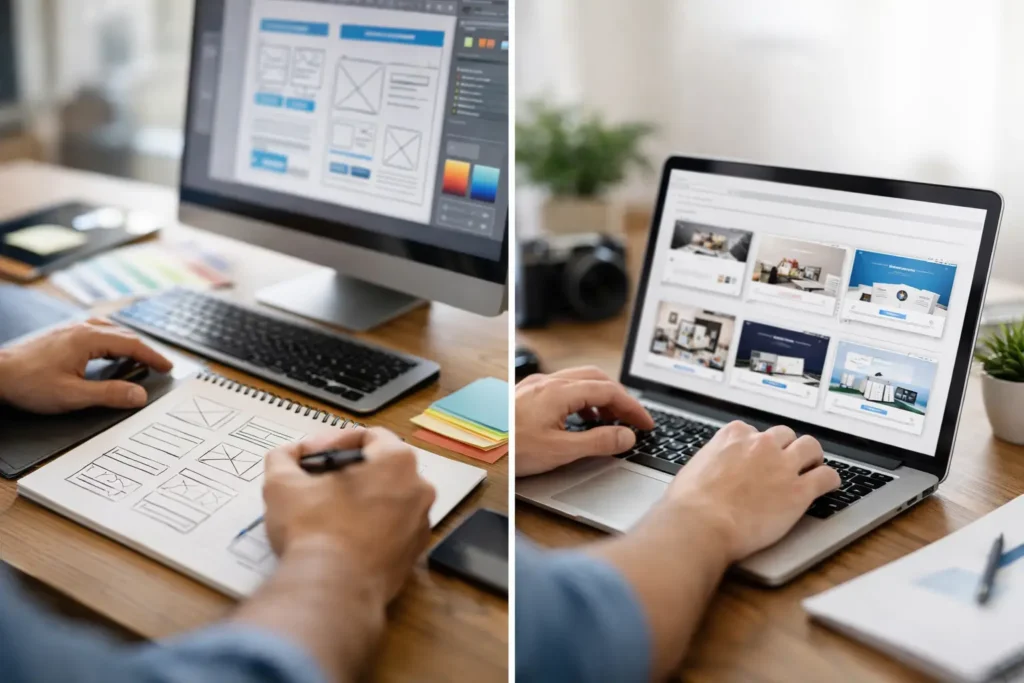
A lot of small business owners do not start by asking for a custom site. They start by asking a simpler question: do I need something fast and affordable, or do I need something built to help my business grow? That is really what the custom website vs template website decision comes down to.
If your website is just there to prove your business exists, a template can sometimes do the job. If your website needs to rank, convert, support ads, and give people confidence to call or book, the answer gets more specific. The right choice depends on where your business is now, how competitive your market is, and whether you want a digital brochure or a real sales tool.
Custom website vs template website: what is the difference?
A template website starts with a pre-designed layout. You swap in your logo, your text, your photos, and maybe change a few colors and fonts. It is quicker to launch, and on the surface it usually costs less.
A custom website is built around your business, your goals, and your users. The page structure, design, calls to action, content flow, and functionality are created to fit how your customers actually search, browse, and convert. Instead of forcing your business into a pre-made system, the site is shaped around what you need.
That difference matters more than most people think. A lot of websites look decent at first glance. The problem shows up later when you try to improve rankings, run ads, add service pages, track leads, or stand out from five local competitors using the same design style.
When a template website makes sense
There are cases where a template is perfectly reasonable. If you are a brand-new business with a tight budget, a very simple offer, and no immediate need for custom functionality, a template can be a practical starting point.
It can also work if speed matters more than flexibility. Maybe you need a basic online presence next week so people can find your phone number, see your services, and submit a contact form. In that situation, getting live quickly may be more valuable than building every detail from scratch.
Templates can also be fine for temporary landing pages, one-page microsites, or businesses that are still testing a concept. If you are not yet sure what services you will focus on, who your ideal customers are, or how your sales process works, going custom too early may be more than you need.
The key is being honest about the role of the site. If it is a placeholder, use a placeholder. Just do not expect placeholder results.
Where template websites usually fall short
Most template websites run into the same issues. First, they are not truly built around your customer journey. They may look polished, but the content flow often feels generic because the layout was designed for broad appeal, not for your business model.
Second, customization often hits a wall. At the beginning, it feels easy to edit. Later, when you want to change page structure, improve mobile layout, add location-specific content, or tailor the design around conversion goals, you realize the template controls more than you do.
Third, template sites can create sameness. If your market is crowded, looking like everyone else is not a small problem. For local service businesses especially, trust is built fast. Visitors are comparing you in seconds. If your website feels recycled, it can quietly hurt credibility.
There is also the performance issue. Not every template is slow or bloated, but many are loaded with design extras, code, and plugin dependencies you do not actually need. That can affect speed, maintenance, and even SEO over time.
Why a custom website can produce better business results
A custom website is not just about appearance. The real value is control.
You control how the homepage guides visitors. You control how service pages are structured for search intent. You control where trust signals show up, how forms are placed, and what action people are encouraged to take next. Instead of living with someone else’s assumptions, you make decisions based on your market and your goals.
For a business that depends on leads, this matters. A custom site can be built around the questions people ask before they hire you, the objections they have, the areas you serve, and the actions you want them to take. That often means clearer messaging, better conversion paths, and stronger performance from SEO and paid traffic.
It also gives you room to grow. Adding new service pages, location pages, galleries, case studies, booking features, or tracking tools is easier when the site structure was planned for expansion instead of patched together later.
Custom website vs template website for SEO
This is one of the biggest deciding factors for many businesses.
If organic traffic matters to you, custom usually gives you a stronger foundation. Not because Google automatically prefers custom design, but because custom sites can be built with cleaner structure, more intentional content hierarchy, faster performance goals, and pages designed around actual search opportunities.
A template site can still rank. That part is important. A bad custom site will not beat a well-built template site just because it is custom. But when two businesses are competing seriously in the same market, the business with better strategy, better content structure, and better control over the site usually has the advantage.
For local SEO, that flexibility matters even more. You may want unique service pages, city pages, FAQ sections, review integration, schema, conversion tracking, and content built around what local customers search for. Templates can support some of that, but they often become restrictive once your SEO needs get more serious.
Budget matters, but so does replacement cost
A lot of business owners compare the upfront price and stop there. That is understandable, but it is not the full picture.
A template website usually costs less at launch. A custom website costs more because there is more strategy, design thinking, development work, and setup involved. But if the cheaper site fails to convert, cannot scale, or needs to be replaced in a year, it may not have been the cheaper option after all.
The real question is not just what you can spend today. It is what kind of return the site needs to produce. If one extra job per month covers the difference between a template and a custom build, then the decision should be based on performance, not just sticker price.
That does not mean every business should spend big right away. It means the website should match the stage and ambition of the business.
Which businesses should choose custom?
If your website plays a direct role in revenue, custom is usually the better long-term move. That includes contractors, home service companies, law firms, med spas, consultants, agencies, and other businesses where trust, search visibility, and lead quality matter.
It also makes sense if you are in a competitive market, have multiple services, need location targeting, or want your website to support ads and SEO together. In those cases, design and structure are not cosmetic decisions. They affect lead flow.
Businesses with an established reputation often benefit from custom too. If you have real experience, strong reviews, and a solid offer, your website should reflect that level of quality instead of looking like a starter kit.
Which businesses can start with a template?
If you are validating a business idea, keeping overhead very low, or only need a simple online presence for now, a template can be enough. The smart move is to treat it as phase one, not the final version.
That mindset changes everything. Instead of overinvesting in a limited system, you launch something clean, useful, and professional enough to support basic credibility. Then, once your messaging is clearer and the business gains traction, you upgrade with purpose.
That is a much better plan than endlessly forcing a low-cost site to do work it was never built to handle.
The better question to ask
Instead of asking whether custom is better than template in a general sense, ask this: what does my website need to do for my business over the next 12 to 24 months?
If the answer is just exist online, a template may be fine. If the answer is generate leads, support local SEO, improve ad performance, build trust quickly, and grow with the business, custom becomes a lot easier to justify.
A website should not create more friction than it removes. It should make your business easier to trust, easier to find, and easier to contact. If you keep that standard in mind, the right choice gets clearer fast.
Sometimes the best move is to start simple. Sometimes the best move is to build it right the first time. The important part is knowing the difference before you pay for a site that looks good but does not really help your business move.